

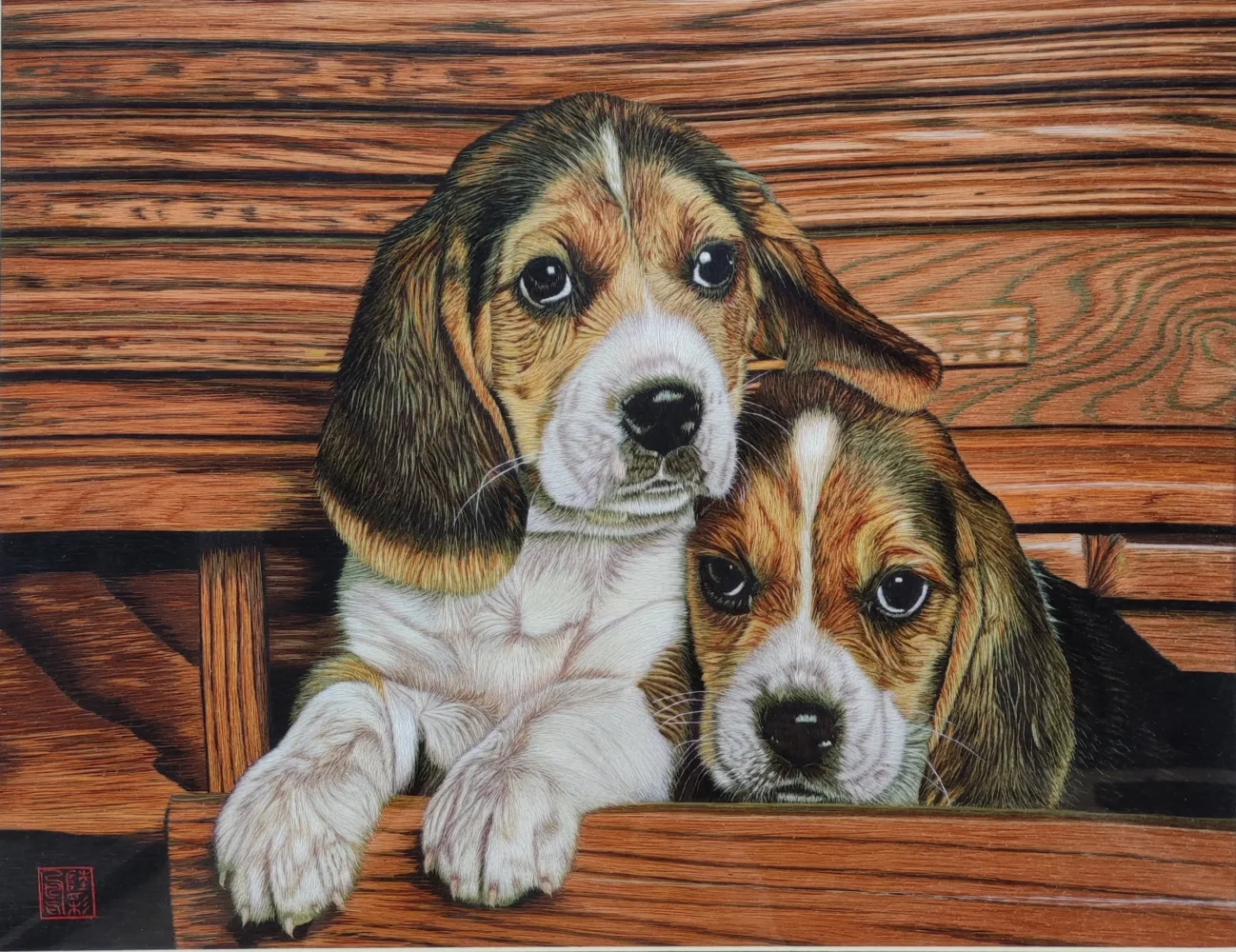
A studio essay on memory, silk, and the difference between preserving an image and keeping a presence.
By Suzhou Threads Studio · Suzhou · October 9, 2026 · 8 min read
The short answer: A photograph can preserve how a companion looked. A hand-embroidered silk portrait changes how that memory is encountered. It is built slowly from fine threads, shaped by a named master, and finished as an object that responds to the light in the room where it lives. It does not replace the photograph. It gives the bond another form.
There is a photograph on our studio desk that we have been rationing for two years. It is not the sharpest image. It is not the one a photographer would choose. It is simply the last one in which she still looked entirely like herself.
Anyone who has lost an animal knows the strange arithmetic of that photograph. First you look at it constantly. Then you look more carefully, as if attention alone might bring back what the image cannot hold. Then you stop opening the folder. The photograph has not faded. Your capacity to meet it has.
When people try to help, they often offer the photograph in another form. A canvas. A photo book. A keychain. A candle with a name on it. Each can be thoughtful. Each can matter. But most begin with the same premise: keep the image.
That premise is not wrong. It is only incomplete.
A photograph is both enough and not enough
A photograph is a small miracle. It keeps a face, a posture, a particular afternoon. It can return someone to you in a fraction of a second. That is not a small thing, and no portrait should pretend otherwise.
But a photograph was made for looking, not keeping in the way grief asks us to keep. It records appearance. It cannot carry warmth, weight, the sound of movement in a hallway, or the ordinary ritual of reaching for a companion who is no longer there.
So we search for another object. Something that can hold more than an image. Something that will not disappear when the phone is face down or the folder is closed.
This is where many memorial gifts stop too soon. A print repeats the photograph on a different surface. A canvas enlarges it. A keepsake places it inside another shape. Those objects can be meaningful, but they still ask the same image to do the entire job.
Sometimes the need is not for the photograph again.
Sometimes the need is for what the photograph could not include: time, attention, and the work of someone who never knew your companion but spent weeks learning their face.
Why a print still feels like the photograph
A printed reproduction preserves an image. A hand-embroidered portrait builds one.
The difference is physical before it is emotional. Printed color stays fixed on a surface. Silk is the surface and the image at once. A single filament of mulberry silk is split by hand again and again, until the finest strands are barely visible. Color is not applied in one flat layer. It is gathered through thread, stitch angle, density, and the changing direction of light.
In the Su embroidery tradition, a dense-and-sparse approach known as xushi allows the image to move between solid form and open silk. Thread gathers where the face needs weight. It thins where the light should pass through. The eye completes what the needle leaves unsaid.
That is why a silk portrait does not look exactly the same from every angle. It should not. A photograph records the light that was present when the shutter closed. A silk portrait continues to answer the light in the room where it now lives.
| Photograph or print | Hand-embroidered silk portrait | |
|---|---|---|
| What is preserved | A recorded image | A translated likeness built in thread |
| Surface | Paper, canvas, or screen | Silk ground and silk threads |
| Response to light | Usually fixed by the printed surface | Changes with stitch direction and viewing angle |
| Time inside the object | The instant of the photograph | The artisan hours required to build it |
| Authorship | Image capture or printing | One named master, from first stitch to last |
None of this makes a print dishonest or a hand-embroidered portrait more real. They are different objects for different needs. A photograph can keep a face. A portrait in silk can keep the act of attention.
What 110 to 250 artisan hours change
A 15 × 15 cm Silk & Shadow portrait takes roughly 110 artisan hours. The larger 26 × 36 cm format takes about 250. From the first approved stitch plan to the final knot, the work usually takes six to ten weeks at the frame.
People often ask whether that time can be shortened.
It can be, but then it becomes a different object. The hours are not decorative. They are the structure of the work. They are spent splitting thread, matching color by eye, changing stitch direction, building the fur in layers, and returning to the same small area of an eye until recognition arrives.
One of our named master artisans begins the portrait and stays with it until the end. There are no factory benches, no anonymous handoffs, no machine pretending to be a hand. The pace is not slow because the studio is disorganized. It is slow because the likeness lives in decisions that cannot be rushed.
For a long time, we thought of the waiting period as a problem to explain. Now we understand it differently. The hours are not an obstacle placed in front of the memorial. They are part of the memorial itself.
That does not mean every family needs a handmade portrait. It means the time should not be hidden behind vague language such as “artisan quality” or “premium craft.” If you commission this work, you should know exactly where the weeks go.
A likeness is not a copy
The aim of a portrait is not to reproduce a photograph pixel for pixel. If exact photographic replication is what matters most, a print will always be the more logical choice.
The work of embroidery begins when the image stops being information and becomes recognition. The slight tilt of the head. The way one ear folds. The softness around the mouth. The expression that appears for only a moment but somehow contains the whole animal.
Every commission begins with a complimentary digital preview. It shows the composition, color direction, and stitch plan before any needle touches silk. Adjustments are welcome at this stage. Nothing is stitched until the family approves the work in writing.
That preview is not a way to delay the commission. It is a way to protect the animal from a generic translation. The portrait should not merely say, “This is what they looked like.” It should make you pause and think, “There you are.”
The finished work is then signed and delivered with a certificate of origin that names the artisan. The Silk & Shadow collection is made in two standard formats. Bespoke commissions are developed privately for families with more than one companion, a larger scene, or a story that needs its own composition.
What a silk portrait cannot do
A portrait cannot reverse a loss. It cannot make grief orderly, and it should never be presented as a replacement for support from people who knew your companion and understand what they meant to you.
It also cannot guarantee an exact copy of a photograph. Silk is not ink, and a master is not a printer. The result is an interpretation made with extraordinary care, but it is still an interpretation.
And it is not for everyone. If you want an accurate reproduction at the lowest possible cost, choose a print without apology. If you want an object that carries proof of human attention, the decision may be different.
That distinction matters because memorial work should not begin with pressure. It should begin with honesty.
A note for the photograph you cannot stop thinking about
There is no hurry.
You do not need to decide before a birthday, an anniversary, or a date chosen by anyone else. You do not need to have the perfect photograph. You do not need to know what size feels right before someone helps you understand the choices.
If all you can do today is open the photograph and look at it, that is enough.
If you are ready to see what it might become, send one image for a complimentary digital preview. Your photographs remain private. The preview is free and carries no obligation. Nothing reaches silk until you say yes.
The finished portrait will not replace the photograph. It will not ask the photograph to be quiet. It will simply sit nearby, built from silk and patience, and give your attention somewhere to rest.
For the companion who shaped your life: one thread at a time.
Frequently asked questions
Is a hand-embroidered pet portrait a good memorial gift?
It can be, but it should be chosen with care. A memorial portrait is deeply personal, and not every grieving person wants to commission one immediately. If possible, ask whether they would value a lasting handmade object before beginning. A complimentary digital preview allows them to see the direction without committing to production.
Can you make a pet portrait from an old or imperfect photograph?
Often, yes. A sharper image with clear eyes and natural light gives the artisan more information, but the studio can sometimes work from older or imperfect photographs. The preview process will show honestly what is possible before any silk is stitched.
How long does a hand-embroidered pet portrait take?
A Silk & Shadow portrait takes six to ten weeks at the frame after the digital preview is approved. The 15 × 15 cm format involves about 110 artisan hours, while the 26 × 36 cm format involves about 250 hours. The preview is usually returned within seven days.
Will a silk portrait look exactly like the photograph?
No. It is a translation into silk, not a photographic reproduction. The goal is recognition: expression, posture, texture, and the qualities that make a companion unmistakable. A printed portrait is the better choice when exact photographic replication is the priority.
Why does a hand-embroidered pet portrait cost more than a printed canvas?
The price reflects hundreds of artisan hours, hand-split mulberry silk, one named master working from first stitch to last, archival framing, certification, and insured delivery. A print reproduces an image quickly. A hand-embroidered portrait creates an original work and carries the time required to make it.